
The next chapter for Tana
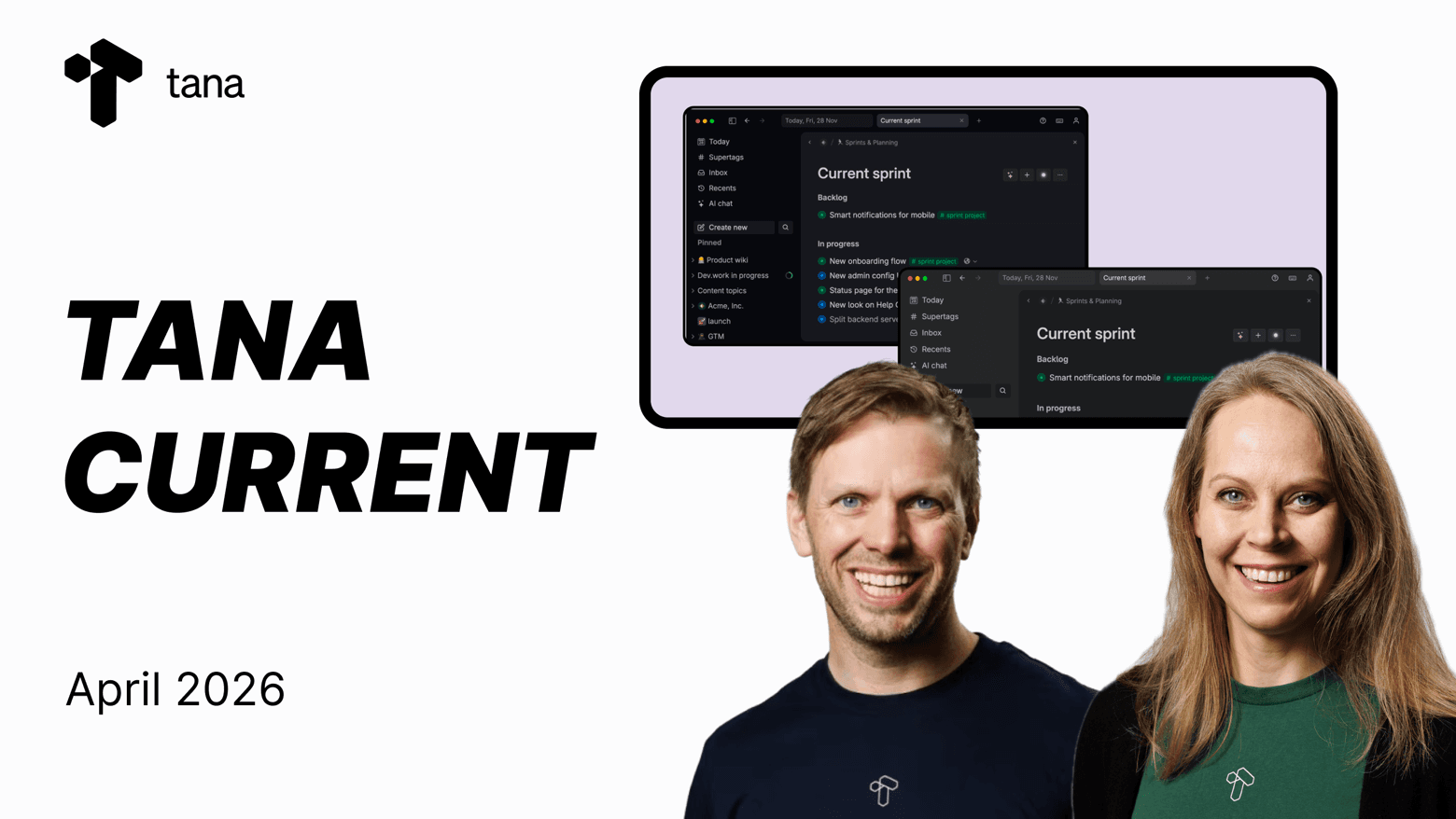
We built Tana to reinvent how humans, teams and computers work together. Now we are launching a new product designed for teams to work better together with AI, while keeping the current product under a new name, Tana Outliner.
Introducing a new Tana
For the past four years, Tana users have helped prove something important: when information is structured well, work gets better. You showed us how powerful a living knowledge graph can be.
You also showed us something else. The version of Tana many of you use today can be incredibly powerful, but it can also be hard to learn, hard to roll out across a team, and hard to bend toward the next generation of AI-powered work.
To bring the power of Tana to teams, we'll soon be launching a new Tana, designed for real-time collaboration.
The current version of Tana will continue as one of two products and will from now on be called Tana Outliner.
Tana in its current form worked. But not for enough people.
If you're reading this, you've probably felt what makes Tana different.
It helps you connect ideas. It lets your knowledge compound over time. It turns scattered notes into something you can actually use. Users said that it "works like my brain".
It also showed us that the same flexibility that power users love can become friction for everyone else. Too much setup. Too much manual configuration. Too much that had to be understood before a team could get value.
It's powerful, but hard to get into. It works best solo, not across a team. And it takes time to really "get it" and keep it maintained.
That's on us. We attempted to redesign Tana several times, but were then faced with the risk of also reducing core features that many power users love and rely on.
That tradeoff became impossible to ignore. We could keep stretching the existing product, or we could build a new foundation that makes Tana more natural for more people.
The real problem isn't note-taking
Over the past year, something else became clear.
The problem isn't how we take notes. It's how work itself is structured.
Today, your work is split across:
- meetings where decisions are made
- documents where ideas are written
- chats where context is isolated
- AI tools where collaboration requires technical skills
Even with AI, most of your work is still fragmented. And adding AI on top of that doesn't fix it.
We've always been on a mission to reinvent how humans, teams, and computers work together. And the most important word in that sentence is together.
We believe real innovation should happen in the way people and AI work together. People will keep working together. Increasingly, they'll work together with AI. And that has to feel natural.
That is why we built a new Tana.
Why we didn't just keep adding on to the existing product
The way people work with information is changing fast. Old problems are now easily solved, and new problems arise daily.
AI is getting better at turning messy input into useful structure. That creates a new opportunity, but it also changes what the product needs to do well. It is no longer enough to help people capture and organize notes after the fact. Increasingly, people want AI to help while the work is happening.
We also learned that collaboration is not a layer you can simply bolt on at the end. Shared work needs a stronger foundation: better real-time collaboration, an integrated way to work with AI, clearer guardrails, a more natural editing experience, and a product that does not ask every teammate to learn an internal system before they can contribute.
Starting over was the fastest way to build that foundation well.
So we decided to rebuild Tana.
Not as a better note-taking app. But as a different kind of workspace.
One where meetings, documents, and AI share the same context, and work gets done in the conversation, not after it.
In the new Tana, your graph is the context and conversations are your prompts. You don't start from a clean slate every time. The system already understands what you're working on.
Why meetings became such an important part of the new product
Most work doesn't start in documents. It starts in conversations.
That might be a team meeting, a customer call, a planning session, a review, or even a solo session where you talk through an idea. This is where context appears for the first time. It is where decisions get made, tradeoffs are discussed, and next steps start to take shape.
But today, meetings are where work gets lost:
- decisions are forgotten
- action items are missed
- context disappears
In most tools, that context disappears as soon as the conversation ends. Then the real work begins somewhere else: writing the spec, filing the bug, updating the project, sharing the decision, assigning the task.
We wanted to fix that at the root. So we built meetings directly into Tana.
Not as recordings. But as part of your knowledge system.
That means:
- your meetings produce finished work, not notes
- having a conversation is all the prompting AI needs
- your knowledge graph builds itself every time you talk
- agents act during the meeting, not after it ends
The goal is simple: Meetings that don't just capture work. They finish it.
The new Tana is built around the idea that conversations should turn into finished work more directly. Instead of simply recording what happened, Tana can help turn it into something useful while you are still in the flow. And for the first time, all of this works on mobile from day one.
What stays the same
The original Tana was built for people who love thinking tools.
The new Tana is built so your whole team can use it.
That means:
- less setup
- less need to understand structure
- more happening automatically
AI helps with the complexity, so more people can benefit from the system.
Or put simply:
We're taking what made Tana powerful, and making it usable.
This is not a rejection of what made Tana valuable.
The new Tana still builds on the same core belief: unstructured information becomes much more useful when it can turn into structured knowledge. Types (Supertags) still matter. Links still matter. Context still matters.
What changes is how much of that structure needs to be built and maintained manually. In the new Tana, more of that work can happen with AI, inside the product, with review and approval built in.
What this means for current users
Tana Outliner is staying. Nothing is being taken away.
The Tana you use today will continue as Tana Outliner.
- It will still be supported
- It will still improve
- Your workflows will keep working
If it works for you, you can keep using it.
At the same time, we are building a new Tana for a different job: making the power of Tana easier to access, easier to share with a team, and better suited to a world where humans and AI work side by side.
There will be a period when the new Tana does not yet do everything Tana Outliner can do. That gap will be real. But we believe this foundation will let us move faster, build more naturally for teams, and bring more of Tana's power to more people over time.
Why we are making this change now
This is a bigger shift than a product update. Because we do not think the future of work will be built around more disconnected tools.
We're moving toward something we've believed in from the start:
A shared system where:
- knowledge is structured
- context is always available
- AI helps you act, not just think
A system where your team doesn't just store information. It builds intelligence over time.
Or as we think about it internally:
From a second brain...to a company brain.
We think the next generation of knowledge work will happen in a shared context, with AI close to the conversation, close to the documents, and close to the decisions that matter. We think the best tools will not just store information. They will help turn it into action.
That is the product we are building.
Not because the old Tana was wrong, but because it taught us what had to come next.
A new chapter
Tana Outliner showed what was possible.
The new Tana is our attempt to make that power more collaborative, more natural, and more useful in the flow of real work.
If you love Tana Outliner, keep using it. If you want a simpler, more collaborative Tana built for the way teams and AI now work together, we are excited to show you what comes next.
We recently showed the new product to our community in a live demo and AMA. The response helped us understand what excites people and where questions remain. We'll continue sharing progress through live events, early access, and our community Slack.
Join the early access list and see the new Tana for yourself.
Explore further